Restaurant Bill Format: Free Word, Excel & PDF Templates
 Bill Generator Team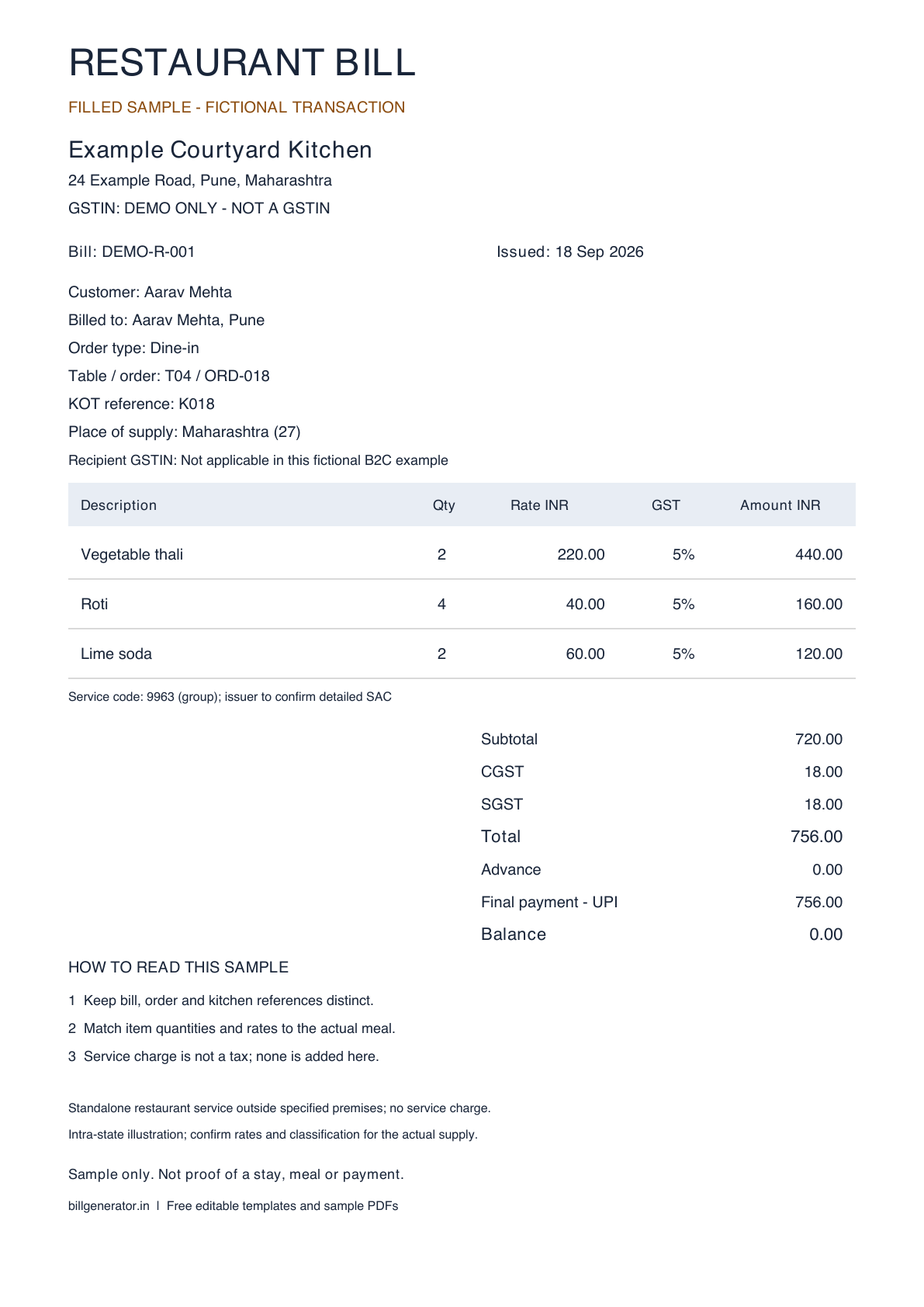
A restaurant bill lists the food and drinks supplied, their quantities and prices, applicable taxes and the amount payable. It should identify the restaurant, bill date and reference, and payment status. Download the free Word or Excel template for an editable layout, or use the filled PDF sample to check the format.
Download restaurant bill templates
- Editable Word template (.docx)
- Excel calculation template (.xlsx)
- Filled sample PDF — SAMPLE / DEMO (.pdf)
The filled PDF and sample image contain fictional information and should be visibly marked SAMPLE / DEMO — NOT VALID FOR CLAIMS.
Arrange the bill so a diner can check the order against the quantities, rates and payment. Keep kitchen references separate from the customer-facing bill number.
| Field | What to enter | Why it matters |
|---|---|---|
| Restaurant identity | Issuer’s legal name, outlet address and GSTIN where applicable | Identifies who supplied the meal |
| Bill number and date | Unique bill reference and actual issue date | Locates the transaction |
| Table or order reference | Table, takeaway or order identifier | Connects the bill to the order |
| KOT reference | Kitchen order ticket reference, if used | Helps reconcile preparation records |
| Customer details | Actual customer or billed-to party where required | Supports correct billing |
| Dishes and quantities | Specific item names and units served | Makes ordering errors visible |
| Rates and discounts | Unit prices and actual discounts | Explains the taxable amount |
| Service classification | Applicable SAC or other classification details where required | Supports tax records |
| Taxes and total | Applicable rates, tax amounts and final total | Enables arithmetic checks |
| Payment | Mode, received amount and balance | Shows whether payment is complete |
For GST invoice and bill-of-supply requirements, refer to the CBIC Tax Invoice, Credit and Debit Notes rules. A KOT is an operational reference and does not replace the customer bill.
Example Courtyard Kitchen, a fictional standalone restaurant in Pune, serves a meal on 18 September 2026. Bill DEMO-R-001 relates to table T04 and KOT K018. Customer Aarav Mehta pays by UPI. This illustration assumes a GST-registered standalone restaurant that is not a specified premises and an intra-state restaurant-service supply taxable at 5% without input tax credit. Actual treatment must be confirmed for the supplier and transaction.
| Item | Quantity | Rate | Amount |
|---|---|---|---|
| Vegetable thali | 2 | ₹220 | ₹440 |
| Roti | 4 | ₹40 | ₹160 |
| Lime soda | 2 | ₹60 | ₹120 |
| Subtotal | ₹720 | ||
| CGST at 2.5% | ₹18 | ||
| SGST at 2.5% | ₹18 | ||
| Total paid | ₹756 |
The balance is zero and no service charge is included. This worked example illustrates one restaurant-service treatment; it is not a universal tax-rate table for separately supplied goods, alcoholic beverages or other supplies. All names and references are fictional, and the downloadable sample should be marked SAMPLE / DEMO — NOT VALID FOR CLAIMS.
Choose the Word template for a blank editable layout, the Excel template for editable item calculations, or the filled sample PDF to see a completed fictional example. No login or email address is required.
The spreadsheet starts with the example meal. Replace the dishes, quantities, rates and customer details before use. Tax rates are editable by row, and the sheet calculates the intra-state CGST and SGST split from the rates entered. Confirm the classification and applicable rates for the real transaction rather than relying on the sample defaults.
The Word version requires manual calculations. Keep a clean master copy of either editable template so a new bill does not inherit an earlier customer’s information.
Restaurant services supplied other than at specified premises are generally covered by the 5% GST treatment without input tax credit for the supplier, while restaurant services at specified premises can fall under the 18% treatment with input tax credit, subject to the applicable conditions. The Finance Ministry explanation of the specified-premises framework explains the distinction. Specified-premises status can depend on accommodation values from the preceding financial year or an applicable declaration, so it should not be inferred only from a diner’s current room bill.
A service charge is not GST. Consumer-protection guidance says restaurants must not automatically add a service charge or make its payment compulsory. A voluntary tip is a separate choice. The July 2026 CCPA enforcement update restates the position. The downloadable template therefore contains no automatic service charge.
The correct document also depends on the supplier’s GST registration and the nature of the supply. A GST tax invoice and a bill of supply are different documents. Do not display another business’s GSTIN or collect tax simply because a template provides a tax field. Refer to the CBIC invoice rules and confirm the applicable treatment for the actual transaction.
A restaurant bill or invoice records what was supplied and charged. A receipt acknowledges payment. One document can show both, provided it clearly states the amount received and any remaining balance. A card-terminal slip or UPI payment screenshot may support proof of payment, but it normally does not contain the itemised meal details required to check the restaurant’s charges.
- Open the restaurant bill generator.
- Enter the restaurant’s authorised business identity and actual bill reference.
- Add each dish or supplied item with its actual quantity and unit price.
- Check discounts, applicable taxes, payments and the final total.
- Preview the completed bill and download the PDF.
If you purchased a meal from another restaurant, ask that restaurant for the original bill, a duplicate or a corrected bill. Use the generator only for transactions you are authorised to document.
A consistent restaurant bill layout makes repeated billing easier to review. Item rows help staff spot omitted dishes, incorrect quantities or calculation errors before collecting payment. Keep a clean master template and save every issued bill separately with its own reference. Review the tax settings whenever the nature of the supply or applicable rules change instead of copying values from an earlier bill.
PDF preserves item columns, totals and payment information when a restaurant bill is shared or printed. Open the exported PDF itself and check that long dish names wrap correctly, every item remains visible and the final total has not moved or been cut off. For an expense claim, retain the genuine restaurant-issued document and any payment evidence required by your employer.
Use these templates for genuine restaurant sales, meals and legitimate record keeping. Do not copy another restaurant’s logo, GSTIN, outlet address, registration details or tax identity into a document you are not authorised to issue. If an original bill is lost, request a duplicate or corrected document from the actual restaurant. The fictional sample is provided only to demonstrate the format and calculations and must not be submitted as evidence of a purchase or payment.
- Entering a dish once when multiple portions were actually served.
- Treating the KOT number as the only customer-facing bill reference.
- Adding a service charge automatically or describing it as GST.
- Applying a copied tax rate without confirming the supply classification and supplier status.
- Marking a bill as paid without reconciling the amount received with the total.
- Reusing another restaurant’s GSTIN, logo or address without authorisation.
Can I download a restaurant bill format in Word?
Yes. The Word file is an editable blank template with fields for the restaurant, order, customer, items, taxes and payments. Enter genuine quantities and rates and check the calculations before exporting. Keep the original blank template separately so the next bill does not reuse another customer’s information or reference number.
Is there a restaurant bill format free download?
Yes. The page provides Word and Excel templates plus a filled sample PDF without requiring sign-in. The editable files are intended for genuine sales and records. The PDF contains fictional data and is marked as a sample, so it must not be used as evidence of an actual meal or payment.
Does the restaurant bill Excel template calculate totals?
Yes. It calculates quantity multiplied by rate for populated rows, calculates tax using the rates entered in the sheet and totals the amounts. It can also show CGST, SGST, payments and balance for an intra-state example. The formulas perform arithmetic only; the issuer must confirm the correct legal tax treatment.
Is service charge the same as GST?
No. GST is a tax, while a service charge is a separate charge. Consumer-protection guidance does not allow restaurants to automatically impose a service charge or make it compulsory. A voluntary tip is also separate from GST. This template therefore includes no default service charge.
Can I use the food bill format for takeaway?
Yes, the itemised layout can record a genuine takeaway order. Replace the table reference with the actual takeaway or order identifier and retain the issuer, date, quantities, amounts and payment details. If the order was placed through a delivery platform, keep the documents issued for that transaction and check which entity issued each charge.
Will this PDF be accepted for reimbursement?
A PDF format alone does not establish a reimbursable expense. Your employer decides which documents and supporting evidence it accepts. Submit the restaurant-issued bill for the genuine meal and any required payment evidence. If customer or company details are missing, request a corrected bill from the restaurant rather than modifying the restaurant’s identity yourself.
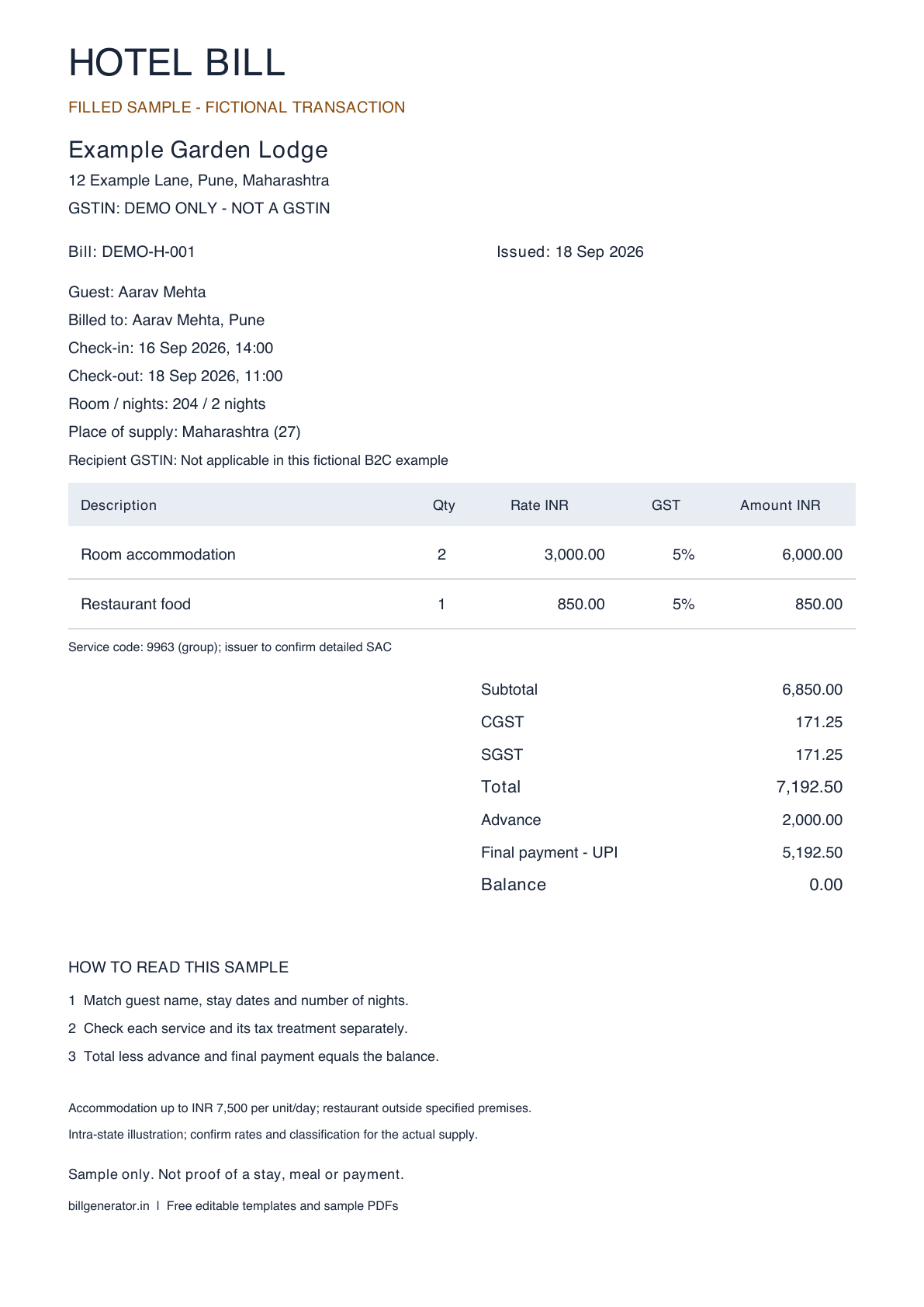
Use the downloadable templates or create a restaurant bill online for an actual sale you are authorised to record. For related travel expenses, see the hotel bill format and cab invoice guide. Browse the bills and receipts hub for other document types.